

MFC vs MDF: Choosing the right product for your project

Over the last decade, melamine faced chipboard (MFC) has grown in popularity over melamine faced MDF (medium-density fibreboard) due to factors like recyclability, health and safety (H&S) regulations, and the wider range of decor options available. However, while MFC offers numerous advantages, MDF still holds an important place in specific sectors due to its unique properties.
At Lawcris, we're expert suppliers of both MDF and MFC, so if you're a tradesman, joiner, kitchen fitter, DIY-er or builder and aren't sure which option is right for a specific project, this guide will help to explain the pros and cons of both MFC and MDF.
What are MFC and MDF?
MFC (Melamine Faced Chipboard) and MDF (Medium Density Fibreboard) are both engineered wood products, but differ in cost, durability, and appearance. MFC offers a wider range of colours and is more cost-effective for many projects, while MDF is denser, holds screws better, and is preferred for intricate machining and high traffic areas like schools. Ultimately, the best choice depends on the specific application's needs regarding aesthetics, budget, and durability.
The Role of MDF in Education and Commercial Sectors

Although there has been a growing shift toward MFC, MDF continues to be the material of choice in certain industries, particularly in the education and commercial sectors. This is largely due to its strength and durability in specific applications. Manufactured from wood fibres, MDF has a dense, uniform structure that provides superior screw-holding capability that are ideal for heavy duty applications such as schools and commercial spaces, where furniture and fixtures are subject to frequent wear. Furthermore, the smooth and uniform surface of MDF is better suited to delicate design details.
However, MDF does come with drawbacks:
Cost
MDF tends to be more expensive than MFC, which can become a critical factor when pricing large projects. If a manufacturer using MDF is bidding against a competitor using MFC, they may find themselves at a disadvantage in terms of cost, potentially losing out on projects.
Weight
MDF is also significantly heavier than MFC, making it more cumbersome to handle and install. This added weight can increase labour costs and time, especially on large projects that involve a high volume of material. While the strength of MDF can be a benefit, its weight is often seen as a trade-off that some manufacturers and clients prefer to avoid.
Popular MDF products

3050mm x 1220mm x 18mm Black Throughout MDF

2440mm x 1220mm x 3.2mm Hardboard MDF

2440mm x 1220mm x 3mm Standard MDF
Popular moisture resistant MDF products

2440mm x 1220mm x 18mm Bio MR MDF FSC
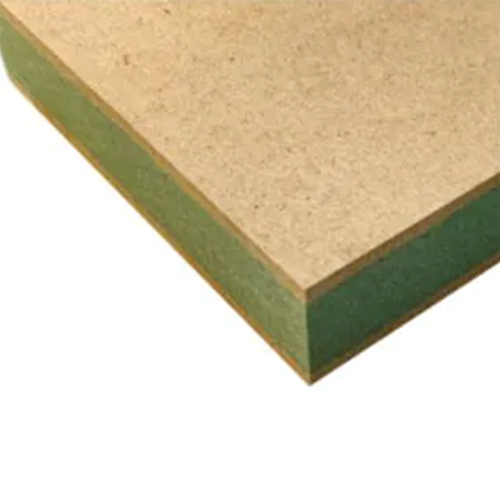
2440mm x 1220mm 22mm Hidrofugo Plus MR MDF

2440mm x 1220mm x 6mm MR MDF
The Decline of MDF in Education and Shopfitting
Historically, MDF was widely used in sectors like education and shopfitting for its durability and workability. However, many of these sectors are now moving away from MDF for a couple of key reasons:
Limited Colour Palettes
One of the main reasons for this shift is the lack of variety in MDF decor options. While MDF is smooth and ideal for spray-paint finishes, the trend in recent years has shifted toward pre-finished boards with ready-made colour options. MFC offers a much wider palette of colours and textures, making it easier for manufacturers and designers to meet the evolving demands of clients. Suppliers like Egger and Kronospan continuously update their MFC ranges with the latest on-trend colours, often taking inspiration from high-end paint brands like Farrow & Ball. This variety in pre-finished decor options gives MFC a distinct advantage in design-driven sectors like education and shopfitting.
Efficiency of Pre-Finished MFC
Many manufacturers in these sectors are now opting for MFC because it eliminates the need for spray finishes, which can be time-consuming and inconsistent. With pre-finished MFC, you can achieve a high-quality, durable finish straight from the supplier, which saves time, labour, and cost. Additionally, MFC allows for easy replacement if a panel needs to be swapped out, ensuring consistency in colour and finish across all pieces.

Why MFC is gaining ground
While MDF is still valued for its strength and screw-holding capability, MFC offers practical benefits that are becoming increasingly difficult to overlook. MFC has become particularly popular in the production of office furniture; not only is it made from thick carcass panels that contributes to its strength, but it can mimic natural wood but it is more cost effective than solid wood.
Sustainability and Recyclability
Manufacturers like Egger and Kronospan have made significant strides in creating closed-loop recycling systems for chipboard, ensuring that the material can be reprocessed and reused, which is not as feasible with MDF.
Wide Range of Colours and Finishes
Created by bonding melamine resin impregnated paper to chipboard, MFC comes in a vast array of pre-finished colours and textures that suit various styles, often inspired by leading paint manufacturers. The ability to select ready-made, on-trend designs helps manufacturers cater to modern aesthetics without the extra step of spray painting.
Cost and Efficiency
MFC is more affordable and easier to handle than MDF, which can help manufacturers price projects more competitively. The lower cost and easier installation make it a favourite for large-scale projects.
Popular MFC Products

2800mm x 2070mm x 18mm H1371 ST19 Grey Beige Rift Egger Melamine Faced Chipboard

2800mm X 2070mm x 18mm K524 SN Pure Surfside Ash Melamine Faced Chipboard

2800mm X 2070mm x 18mm K543 SN Sand Barbera Oak Melamine Faced Chipboard
So, MFC vs MDF, which is better?
There are a lot of similarities between these two sheet materials, both offering a smooth surface, and both made using high pressure and wood waste - wood fibers in the case of MDF board and wood chips with MFC – there are numerous differences that are making MFC an increasingly popular option.
Ultimately, while MDF still has a clear role in the educational and commercial sectors, MFC’s versatility, cost-efficiency, and recyclability are propelling it into the forefront of manufacturing. As manufacturers aim to balance sustainability with performance, MFC’s broader colour palettes and practical advantages are reshaping how projects are designed and completed. The future seems to lie with MFC, but MDF will remain a valuable material in select high-durability applications where strength and workability are essential.
| Feature | MDF | MFC |
| Core Material | Wood fibres bonded with resin | Wood chips/particles bonded with resin |
| Surface Finish | Smooth, plain (needs paint, veneer or laminate) | Pre-finished with melamine layer |
| Strength | Dense and strong but can bend under heavy loads | Lighter, less dense but good for flat panels |
| Weight | Heavier | Lighter |
| Moisture resistance | Poor unless moisture resistant MDF is used | Better surface resistance, but core is still vulnerable to excessive moisture |
| Cost | Generally more expensive | Usually cheaper |
| Typical uses | Painted furniture, doors, mouldings, wall panels | Flat-pack furniture manufacturing, cabinets, wardrobes, shelving. |
Are you looking for engineered wood products?
At Lawcris, we stock a huge range of MDF and MFC to suit your project needs.
Regardless of whether you choose MFC or MDF, both of these engineered wood product options are typically more cost effective than solid wood solutions.
If you're still not sure where you sit on the MFC vs MDF debate, or are considering other engineered wood products, contact our team today for more information and help making informed decisions about your designs!
MFC v MDF FAQs
What are the main differences between MFC and MDF?
There are a number of key differences between MFC (melamine-faced chipboard) and MDF (medium-density fibreboard). MFC advantages include a wider range of colours, textures, and affordability, ideal for design-driven projects including kitchen and bathroom applications where aesthetic appeal is just as important as functionality, however the exposed core of MFC requires edge banding. The advantages of MDF, on the other hand, include strength, durability, and screw-holding capability, making it suitable for high-wear environments like schools.
Which is more sustainable, MFC or MDF?
MFC is generally more sustainable than MDF. MFC benefits from closed-loop recycling systems established by manufacturers like Egger and Kronospan, allowing for reprocessing and reuse. MDF recycling is less feasible.
In fact, with a global push to have more eco friendly options in building materials, manufacturers are finding new ways to ensure the increased sustainability of MFC, with more than 50% of manufacturers adopting environmentally friendly practices in MFC production.
Which is cheaper, MFC or MDF?
MFC (Melamine Faced Chipboard) is usually cheaper than MDF. It’s made from wood chips bonded with resin. This resin and chipboard core is then finished with a melamine coating, which keeps manufacturing costs low, especially for large panels used in kitchen cabinets and furniture.
Which is stronger, MFC or MDF?
MDF is typically stronger and denser than MFC. Its fine, uniform structure gives it better resistance to bending and splitting, and it holds screws more securely, particularly at the edges. While MFC can be sufficiently rigid for many uses, it is more prone to chipping and edge failure under stress, making MDF the more robust material overall.
To put simply, MDF is stronger and denser overall
Better resistance to bending and splitting
Holds screws more reliably (especially in edges)
Where as MFC is more rigid over large spans, but
More prone to chipping
Weaker screw-holding, particularly at the edges
When should I use MDF and when should I use MFC?
The choice between MDF and MFC will depend on your specific applications. Use MDF when:
You need a smooth finish ready to paint
Edge strength and screw-holding are important
You want a higher-quality painted finish
You need to easily be able to cut to size
Common uses include painted cabinet doors, decorative panels, wall panels, and trims.
However, you should consider using MFC when:
You want a ready-made decorative finish (no painting required)
Cost efficiency is important
You’re building flat-panel furniture or cabinets
You need fast installation
Common uses: kitchen cabinets, home and office furniture, and shelving.